
 Donate
Understanding Hip Dysplasia
Hip dysplasia is a general term for infantile hip instability, dislocation, or shallowness of the hip socket. Hip instability and dislocation are more likely to occur during infancy, while a shallow stable socket is more often discovered in adolescence or adulthood.
The infant and child type is often referred to as Developmental Dysplasia of the Hip or DDH. DDH is generally the preferred term for babies and children with hip dysplasia because this condition develops around the time of birth, including after birth. The term Congenital Dislocation of the Hip is rarely used today because the word congenital means the condition is always present at birth and is usually associated with a defect where something is missing or added to normal tissue. In the case of DDH, the infant/child’s joint is otherwise normal except for the instability.
Hip dysplasia diagnosed during adolescence or adulthood is often called acetabular dysplasia because the socket (acetabulum) is shallow and does not fully support the ball (femoral head).
These are some of the terms used for hip dysplasia depending on severity and time of occurrence. These names include:
- Hip Dysplasia
- Developmental Dislocation of the Hip (DDH)
- Hip Dislocation
- Developmental Dysplasia of the Hip (DDH)
- Acetabular Dysplasia
- Congenital Dislocation of the Hip (CDH)
Hip Joint Anatomy
The hip is a “ball-and-socket” joint that is held together by ligaments.
The ball is called the “femoral [fem-er-uhl] head” which is the top of the femur or thigh bone.
The socket is called the “acetabulum” [as-i-tab-yuh-luhm] and is a part of the pelvis.
The femoral head fits into the acetabulum creating the hip joint. This joint is normally held tightly in place by the surrounding ligaments and joint capsule.

Severity of Infantile Developmental
Dysplasia of the Hip (DDH)
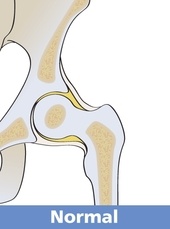
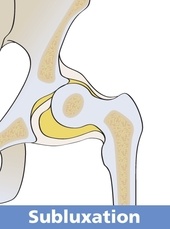
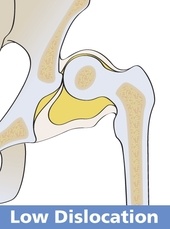
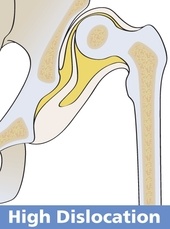
Types of hip dysplasia
Hip dysplasia has a wide range of severity. In some children, the ligaments around the hip joint are loose allowing the hip to subluxate. This is when the ball is no longer centered in the socket. Other times the ball is slightly or completely dislocated from the socket.
What is adolescent and adult hip dysplasia?
Adults with hip dysplasia have a hip socket that is too shallow to support the ball of the hip. The ball is called the femoral head and the socket is called the acetabulum. Some adults have leftover problems from childhood hip dysplasia but most adults never knew they had a problem until their hip started hurting.


A joint that is the wrong shape or shallow will wear out faster than one that has a more normal shape. The smooth surface of the joint has a thin layer of cartilage that can’t be repaired or re-grown by the body. This cartilage surface needs to last a lifetime, or stiffness and pain occurs as the joint wears out.
1 in 10
infants are born with hip instability.
1 in 100
infants are treated for hip dysplasia.
1 in 500
infants are born with completely dislocated hips.
1 in 10
total hip replacements is because of hip dysplasia.
9x
Adult hip dysplasia 9 times more common than infantile hip dysplasia.
<50 years
The most common cause of hip arthritis before age 50 is hip dysplasia.
How Common is Hip Dysplasia or DDH?
Hip instability is the most common abnormality in newborn infants. This may range from mild looseness to complete hip dislocation. Stable adolescent or adult hip dysplasia is actually nine times more common than infantile variety but cannot be detected by current methods. Together, these two types of hip dysplasia – infantile and adolescent – account for approximately 10% of all total hip replacements in North America, and hip dysplasia is the most common cause of hip arthritis in women younger than fifty years of age.
Mild infantile hip instability resolves naturally in most infants during the first few weeks of life, but some infants need evaluation or treatment depending on persistent hip instability, or hip dislocation.
 Hip Dysplasia
  Hip Dysplasia
  Hip Dysplasia